


I have a link for [LoC] (stands for Live on Course) at the bottom of this article. Please read the article first for context then please jump in, explore it, and send me feedback in the comments.
The Problem
A few weeks ago I released an episode about friction in the Cocodona 250 live coverage.
Not because the coverage was bad. Mountain Outpost proved there is real demand for long-form live ultra running coverage. Cocodona specifically brought tens of thousands of people into a 250-mile race across Arizona for multiple days.
The issue was friction.
The race regularly became difficult to follow between checkpoints. Viewers would enter the stream and struggle to understand who they were watching, what mattered, what had changed, or why a moment was important.
The audience assembled the race themselves.
The Idea
So I built a working prototype.
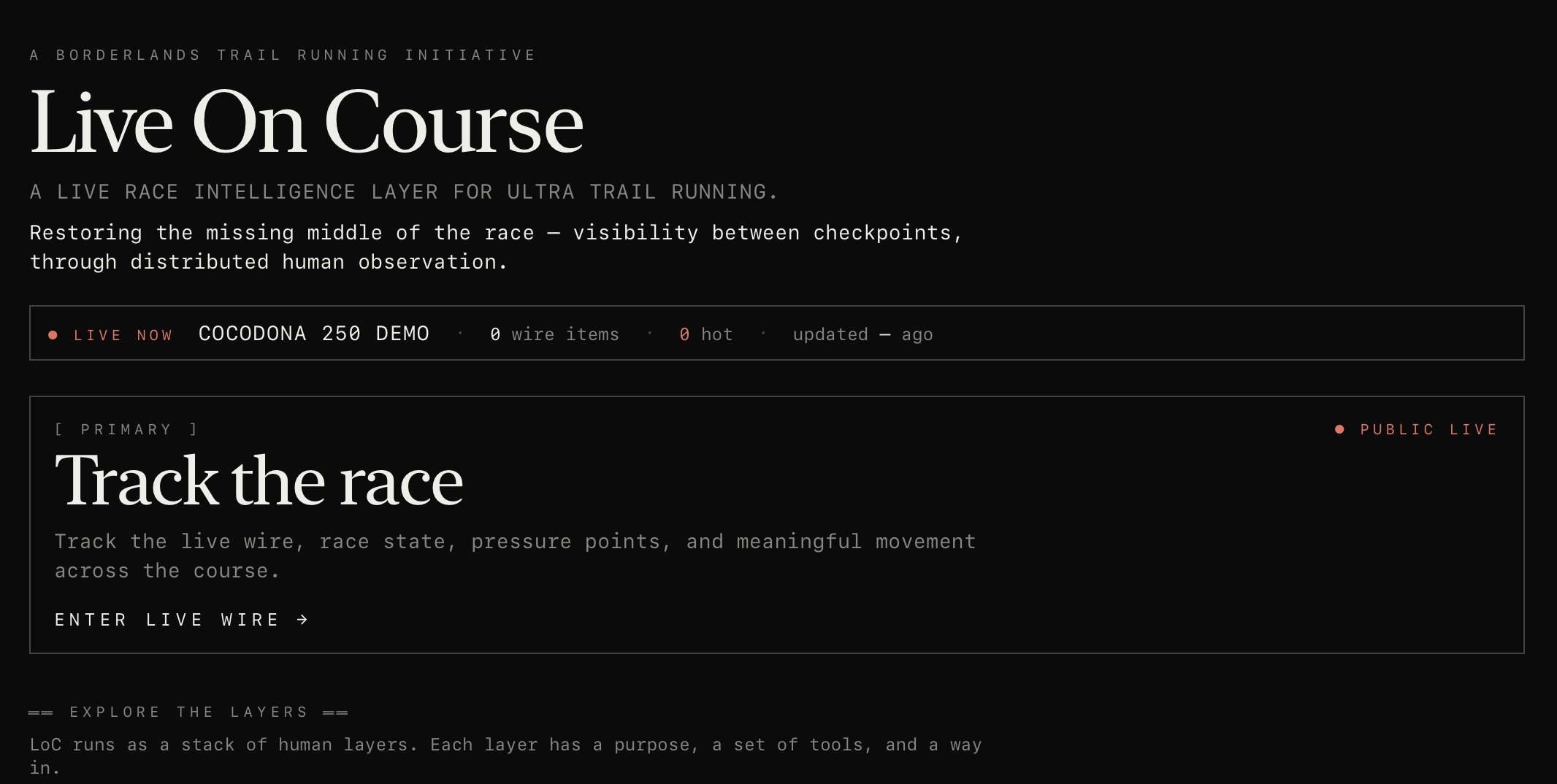
It’s called [LoC].
[LoC] is a live race intelligence system for ultra running built around distributed human observation.
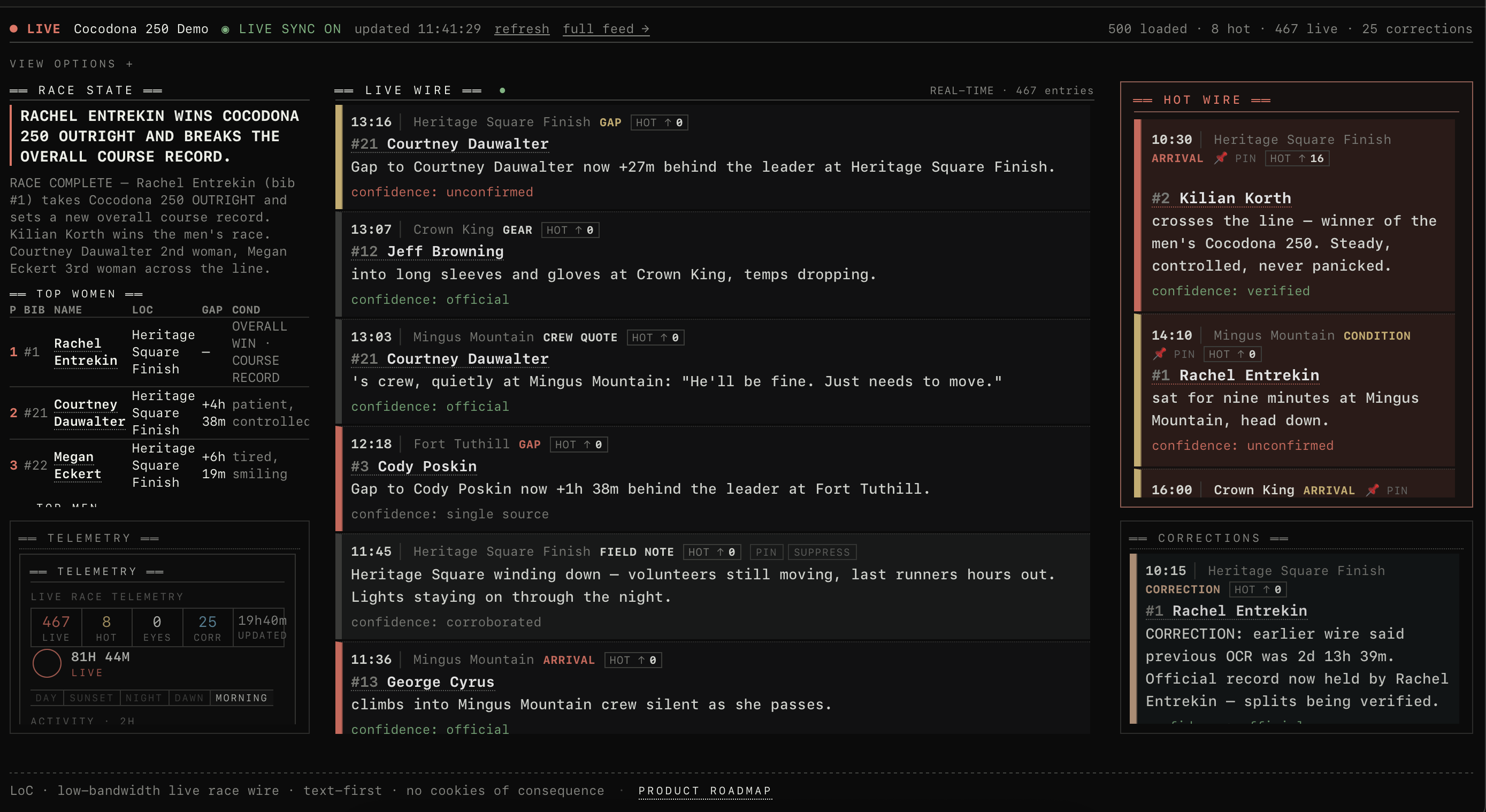
People positioned throughout the course submit short field reports in real time about athlete condition, tactical shifts, weather, crew behavior, atmosphere, emotional moments, and developing race situations.
The system is designed around human moderation, verification, editorial judgment, and routing before information reaches commentators or viewers.
Fans get a public-facing live wire that they can dub ‘hot’ where the top 10 wires move to the hot wire.
Commentators and producers get a deeper intelligence layer designed to help them better understand what is happening between checkpoints before cameras or GPS trackers fully explain it.
Not X (Twitter)
Most people will immediately think this is just X for races.
It’s not.
X forces the audience to determine what is true, what matters, and what is noise.
LoC is designed around moderation, verification, editorial judgment, and routing before information reaches commentators or viewers.
Furniture in Coverage
One concept that came to mind while building this was “furniture.”
In another life I was a professional and mediocre musician and songwriter. Good songs have furniture. Small details that let you live inside them.
Furniture is the texture cameras often miss. Volunteers sensing someone is cracking before the splits show it. Tension building at an aid station before the leader arrives. A runner taking ice for the first time all day.
There’s an entire ecosystem in those details.
Why This Matters
The system is less about catching singular historic moments and more about sustaining meaningful coverage for 60+ straight hours without the race emotionally flattening between checkpoints.
I think ultra running’s athletes are outgrowing the current fan experience.
Better coverage keeps viewers connected longer. It slows exits. It makes races easier to enter midway through. It helps commentators become authorities on the race instead of reacting to scattered information in chats and group texts.
This model potentially allows ultra running to become more professional without removing the community layer that makes the sport unique.
About [LoC]
I modeled LoC more like a Bloomberg Terminal than a social platform.
Dense information, monotype fonts, low bandwidth, fast load times, text-first design.
Fans can follow incoming field reports and elevate the most important updates onto the hot wire.
But the system is really optimized for moderators and commentators.
The goal is simple:
MISS THE COVERAGE, MISS THE RACE.
The live broadcast should become the deepest live layer of race intelligence happening on the course.
Link + Final Notes
Explore → [LoC].
While it does have a mobile version, it is best experienced on desktop.
The product roadmap is public, along with a breakdown of how the system works and the ways I think it could fail.
We understand there could be questions about athlete dignity and athlete strategy.
I want feedback for this. Where does this work? Where does it fall apart? What makes it better? Tell me in the comments.
Disclosures
This prototype was built almost entirely with modern AI tooling.
LoC is functional right now. It is not race-ready.
I don’t know if this becomes a real company, a broadcast tool, or something else entirely. I mostly wanted to see whether the idea could exist outside criticism.
If LoC eventually proves valuable, I’ll build a sustainable business model around it. For now, I want to test whether it actually improves live race coverage.
We also understand that increased real-time visibility could eventually influence race dynamics themselves, particularly around athlete strategy and crew behavior. Part of this project is exploring where better coverage improves the sport and where visibility may need boundaries.
this is a really creative way to solve an equipment and technology issue that is able to be solved for today. i have a piece coming out on wednesday along those lines!
I love this! If it ever progresses to where you need high-quality, AI-ready course data, let me know. :)